
Spotlight.
Ria Andrews
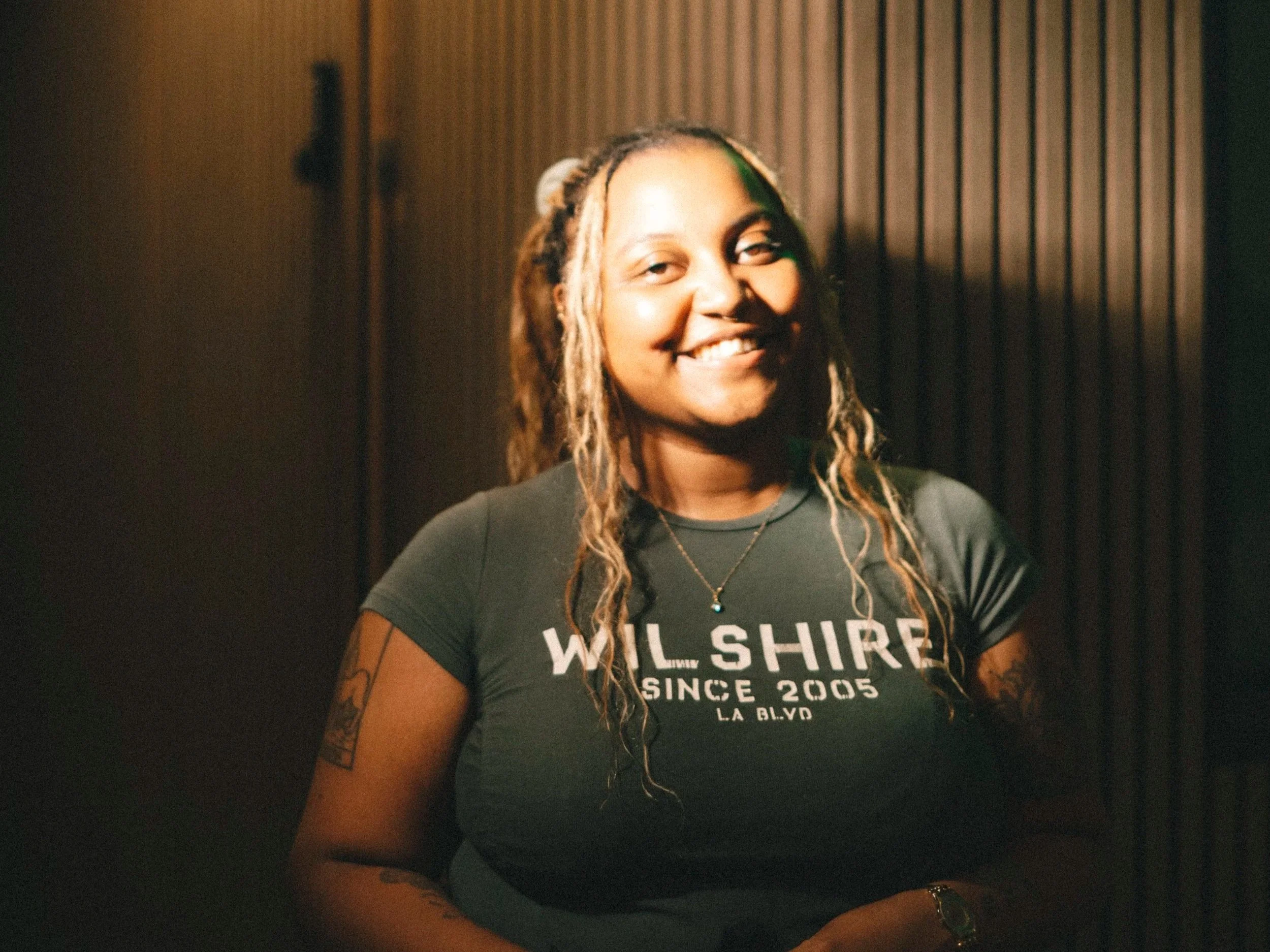
INTRODUCTION
Ria Andrews (she/her) is an Edinburgh-based creative polymath, working across music, photography, and poetry. Her work explores identity, representation, and heritage through an intersectional, anti-racist lens, often centering joy as a radical act. Deeply informed by her own cultural background (growing up in South London and of Grenadian heritage), Ria’s practice invites others to consider what culture means to us individually and collectively. She has a monthly residency on community radio station EHFM, 'liming' that spotlights Caribbean music as well as featuring Black Diasporic genres. She strives to make arts more accessible for everyone - especially, but not limited to, those from marginalised communities, that she is also part of.
INTERVIEW
How did you get into your creative practice? What initially inspired you?
I did a lot of these things when I was younger: I sang from when I was three and the radio was always playing on car journeys for as long as I can remember. I don't think there was ever a moment where I didn't have my headphones on and a CD player with me wherever I went, when I was a child - so I didn't envision a future where I didn't have a career in music. As for writing, I saw it as an outlet for my feelings and the best way of working their complexities; I still do. That and I had a particularly over-active imagination, I loved telling stories in music, poetry and prose and that never went away.
I think creating music and songs were always something I did on the side, as I was scared there wouldn't be room for me to be in the creative industries since I wasn't seeing many people that looked like me, doing what I wanted to do. My family was scared about whether having a career in the creative industries was viable as a Black woman too. Then as I got older (and with the help of a quite frankly amazing psychologist I visited once), I realised that if this continued to be a hobby and not something I pursued and at least tried to see where it could take me, I would never truly be happy. The pandemic also served as a jolt that I needed to really invest in this and not forget my purpose. As for photography, it was applying for the Stills School programme as I was at the upper age-limit to get on the programme. I thought "well, this is my last chance to try this new skill on a free course, so...why not?"
What themes do you tend to interrogate in your creative practices?
I look at how my culture and identity has shaped how I move through the world and look at what Black British culture more widely looks like across mediums of poetry, photography and music. Photography especially, I got into after the realisation that so many photos I was seeing of Black and People of Colour were of us protesting or in distress, which have their importance and necessities in documenting our experiences and contexts. I also wanted to document our joy and see that as a radical act, as those who like how the systems of oppression function definitely don't want to see us happy. I want to contribute to putting more Black and POC joy into the world, as we need to have those moments documented too - and by us.
What is your favourite project you’ve ever worked on and why?
I've worked on so many great ones but if I'm allowed to say one of my own, it would be Talawa Mama. ('Talawa' like the patois phrase " we likkle but we talawa", meaning we may be small in number, stature or underestimated, but we're strong....mighty. 'Mama' being a term of endearment my Grandparents use when speaking to me, my sister or my niece. If it wasn't for my grandparents, I don't believe I would be as connected to my heritage as I am today which I'm incredibly grateful for, so this is a way I find myself taking them on this journey with me). It's a community-centred 'party night', which I refrain from calling a club night since I don't necessarily feel that's at the centre of it, even though having a night for Caribbean music is what inspired the idea. I invite Caribbean caterers, Black and DJs of Colour who play Caribbean genres to play and we eat a little, and have a lime before we get to dancing. The profits from the event then go to a charity or fundraiser with links to the Caribbean.
I love it because I really wanted to create a project that is intergenerational where all ages of the Caribbean community - and those who enjoy it and want to learn more - could come together and socialise; some of my favourite moments have been witnessing all ages dancing side by side to my favourite genres of music. It's also allowed me to make so many new meaningful connections with collaborators and audiences I've met through doing this event.
What advice would you have for creatives of colour looking to get into your creative practices?
There's so much I would want to say on this! But I'm going to do my best to limit myself to three gems that I've discovered while developing my creative practice(s) that has shaped me the most:
Allow yourself to be rubbish at something on the first go and just start. I found myself to be such a perfectionist, for reasons personal, but also acknowledging how my identity additionally reinforces these tendencies in the systems we live in and through, but I think if I didn't let that go to some extent, I wouldn't have been able to fail, learn from those mistakes or take massive risks that had great pay offs. If you start now, where you're at currently, you give yourself plenty of time to grow your creative practice as talent needs to be nurtured over time, and enriched by experience(s).
Say "Yes!" to opportunities to learn new things that may not necessarily neatly fit into your idea of the career you envisioned for yourself from when you were younger - you never know where it would take you. Apply for that workshop that is competitive for places as you could be one of the few selected. I became a DJ because someone literally said "Hey, do you want to learn how to DJ for this Uni Radio Society social?" and I challenged myself to say "yes" to things for a period of a year. I always knew I wanted a career in music, I just thought that would be solely as a singer/musician and now I've found immeasurable joy in being a DJ.
Collaboration is key. I know it can still sometimes feel like we are competing for the same place due to underrepresentation in the industry, however in connecting with fellow creatives of colour, that I saw working in the same creative areas that I'm interested in who are also, really helped me develop my own creative practice. I've learnt so much from my peers and they've inspired new ideas in my creative practice from conversations we've had and encouraged me to be better. Having a strong, supportive community is so important in industries like these.
Oh and go out to experience things as much as you can, be a sponge when it comes to experiencing the art that you want to create as art isn't created in a vacuum. (I know that was technically four, but that last bit is essential!).
What are you currently working on?
I've got a sort-of secret project I'm working on (I say sort of secret because a few potential collaborators know about my idea as the planning is underway and the team being assembled) which I believe is bringing something new to club culture and exploring how this integrates with various communities and wellbeing. It's especially for those who don't think the club is somewhere they'd be out late dancing in. I'm hoping to take that one global (!) with its roots being firmly in Edinburgh.
Additionally, I've still got my ongoing photography project of Joy on Film and I'm looking to start a new series: Black Birthdays - as the birthdays I've photographed so far I've found really special, so why not have a film photography series of us celebrating our birthdays?
DISCOVER MORE: