
Spotlight.
Paria Goodarzi
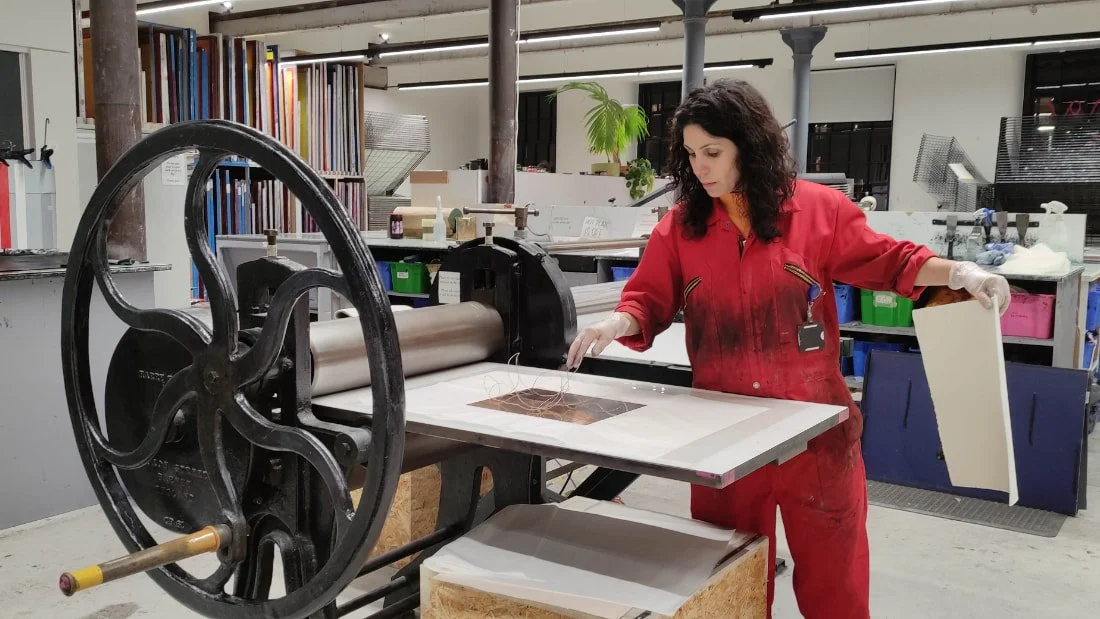
INTRODUCTION
Paria Goodarzi is an Iranian-born artist, socially engaged art practitioner and PhD researcher at the University of Glasgow. She is a member of the UNESCO RILA Affiliated Artist Network and the Young Academy of Scotland.
Paria holds a BA (Hons) in Textile Design from the University of Science and Culture in Tehran. She later studied Sculpture and Environmental Art at the Glasgow School of Art and completed a Master’s degree in Adult Education, Community Development and Youth Work at the University of Glasgow.
Her artistic practice focuses on cultural and political movement, translocation, the contemporary human condition, cultural identity and displacement. Working across a range of disciplines, she examines how identities are formed, negotiated and represented, frequently through collaborative, participatory and socially engaged approaches.
A significant part of her practice involves developing socially engaged art projects that respond to questions of cultural belonging, representation and displacement. She co-founded the art initiative Collective Resonance to support the wellbeing and visibility of people from diverse cultural and social backgrounds by creating opportunities to engage with creative practice, community participation and cultural organisations.
INTERVIEW
How did you get into your creative practice? What initially inspired you?
I began my creative practice as a visual artist, but over time I became more interested in what could happen when art was made collectively rather than individually. I found myself drawn to the conversations, relationships and unexpected exchanges that developed during community workshops.
My own experience of migration also changed how I understood art. Moving between Iran and Scotland made me think more deeply about memory, language, identity and what it means to belong to more than one place. I became interested in the ways people carry home with them through objects, food, stories and everyday rituals.
This gradually led me towards socially engaged and participatory art. What continues to inspire me is the possibility of creating a space where people can meet, make something together and feel that their experiences are recognised.
What themes do you tend to interrogate in your creative practices?
My practice explores migration, displacement, belonging, memory and identity, with a particular interest in how these experiences shape everyday life. Rather than focusing only on major events or dramatic narratives, I examine the quieter ways in which migration is lived through relationships, routines, language, memory and a changing sense of home.
I often work with people who are navigating different cultures, languages and social expectations. Through my projects, I consider questions such as: What does home mean after migration? How are memories carried, reshaped or passed between places and generations? Whose experiences are made visible, and whose remain overlooked? How can people take greater control over the ways their identities and stories are represented, rather than being defined by dominant cultural narratives?
Gender and care are also central to my work, particularly the frequently unrecognised emotional, domestic and caring responsibilities carried by migrant women.
What is your favourite project you’ve ever worked on and why?
One of my favourite projects has been Monuments for the Present, a collaborative body of work developed over nine months through conversations, workshops and collective making. The project brought together film, sculpture, public billboards and temporary monuments made from soap to question whose histories are represented in public space and how monuments might be reimagined for the present.
The project emerged at a time when public monuments across the UK were being challenged for reinforcing dominant narratives of national identity, colonialism and white supremacy. Working with participants from the Maryhill Integration Network, we explored how public space could make room for more diverse histories, experiences and forms of representation.
A central theme was the experience of time. We discussed how time can feel different depending on a person’s circumstances: it can pass quickly when we are active, but feel suspended during periods of waiting and uncertainty. These conversations highlighted the difficult temporalities experienced by people navigating immigration and asylum systems. Waiting for decisions, documents or permission can shape everyday life both psychologically and physically.
What made the project particularly meaningful to me was the way these individual experiences became part of a shared artistic process. Rather than creating a single permanent monument, we produced temporary and evolving forms that reflected fragility, resilience and change. The soap monuments, for example, challenged conventional ideas of monuments as permanent, authoritative and fixed.
The project was co-developed through the Monuments for Equality creative initiative and It was presented at the Centre for Contemporary Arts, the Byres Community Hub at the University of Glasgow, and on public billboards across Glasgow as part of Glasgow International, Refugee Festival Scotland and the Common Ground Festival in June 2024.
What advice would you have for creatives of colour looking to get into your creative practices?
Your experiences, cultural knowledge and ways of seeing the world are valuable, but you should never feel responsible for representing an entire culture or community. You are allowed to explore migration, racism and identity, but you are equally allowed to make work about joy, imagination, nature or anything else that matters to you.
For anyone interested in socially engaged practice, I would say: begin by listening. Do not enter a community believing that you already know what people need. Build relationships slowly, be clear about your intentions and create the work with people rather than for them.
Find other artists and organisations that support creatives of colour. Those relationships can provide encouragement, knowledge and a sense that you are not working alone.
I would also recommend documenting your practice, applying for opportunities even when you feel uncertain, and learning to say no when an opportunity does not respect your values, time or labour.
What are you currently working on?
I am currently undertaking a PhD entitled Negotiating Identity in the Iranian Diaspora: Exploring Representations of Exile through Community Education and Socially Engaged Art. My research examines how participatory arts practices can support Iranian migrant women in Scotland to explore the everyday legacies of conflict, migration and displacement.
Alongside my doctoral research, I continue to develop and facilitate community arts projects with migrant, refugee, marginalised and underrepresented communities, working with organisations that aim to increase their visibility, participation and empowerment. I also work within the Scottish Prison Service, using creative practice to support social change, self-expression, mental health and wellbeing among people in custody. These different strands of my practice are connected by my interest in art as a space for listening, participation, relationship-building and collective representation.
DISCOVER MORE: