
Spotlight.
Rudy Kanhye
INTRODUCTION
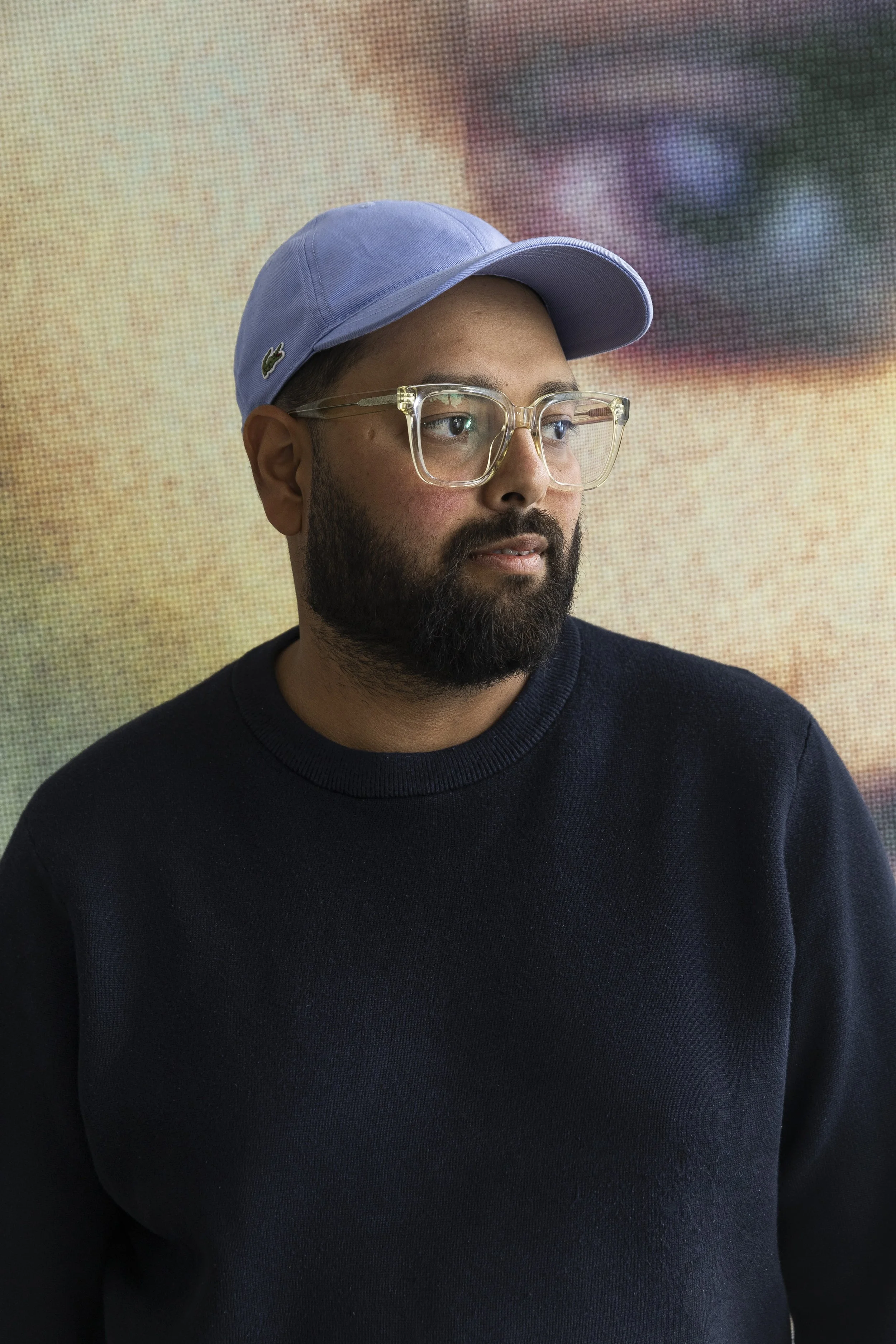
Rudy Kanhye is an award-winning French transdisciplinary visual artist, curator, researcher, and environmental arts producer currently based in Glasgow, Scotland. As a disabled BIPOC artist of South Asian and Portuguese descent, Kanhye's work is heavily informed by his working-class background, mixed-race heritage, and lived experience with disability. His multidisciplinary practice spans across sculpture, screen printing, glass prints, painting, poetry, installations, and alternative mediums like growing and cooking practices
INTERVIEW
How did you get into your creative practice? What initially inspired you?
I come from a hardworking, working-class family. As a first-generation French and the son of immigrants (Portuguese and Mauritian), culture wasn't about high-art status or gallery openings. My first exposure to formal art happened through school visiting museums on class trips.
For a long time, though, my entire world was sports. I played as a competitive football goalkeeper until I was 17. Being a goalkeeper is intense you stand alone, read the whole pitch, anticipate every movement, and handle constant pressure. When my athletic career ended at 17, it was a major turning point. I needed somewhere to channel that discipline and focus, so I started taking art lessons provided by the local council. Those council classes took place inside a local art school, ENSA Dijon the very building I would go on to study in as a full-time art student. My inspiration came from bridging these worlds: taking the discipline from sports, honouring working-class roots, and using visual art to bring those lived stories into spaces that often overlook them.
What themes do you tend to interrogate in your creative practices?
The themes I tend to go back to are:
Identity, Class & Migration
Food & Decolonial Archives
Institutional Critique & Spatial Justice
Memory & Resistance
My creative practice interrogates how formal institutions shape history, approaching art-making as an open-ended process of storytelling. I use food, imagery and everyday objects as accessible archives to trace trade routes, colonial legacies, and acts of resistance across the Indian Ocean and Atlantic. By bringing tactile, shared memories into galleries, I work to dismantle spatial gatekeeping challenging who official histories remember while keeping the space open to wonder and shared imagination
What is your favourite project you’ve ever worked on and why?
My favourite project is Silver Island, a collaborative project created with Lauren La Rose. It holds a deeply personal space in my practice because it directly connects my artistic research to my own roots. The title references Dina Arobi an old name given to Mauritius during early Arab maritime trade, often linked to myths of hidden treasure. But for us, the real treasure of the island isn't gold; it’s the living archive of human memory, migration, and resistance. The project bridges two spaces tied by trade and empire Scotland and Mauritius exploring the legacies of slavery and indentured labour.
Exhibiting Silver Island at Aapravasi Ghat in Port Louis—the actual historic site where my ancestors arrived in 1870 as indentured labourers was an incredible moment. As a first-generation French of Mauritian heritage, returning to Mauritius with this work wasn't just an art exhibition; it was a way to connect my family's story back to the island.
What advice would you have for creatives of colour looking to get into your creative practices?
Let’s be honest, the mainstream art world is inherently racist, classist, and ableist. It was built by and for a very specific demographic, and its institutional structures from funding access and physical space setups to unspoken gatekeeping are designed to exclude us or reduce us to token diversity boxes. Expecting these systems to automatically validate you will only exhaust you.
My advice is to navigate this reality with strategy, self-preservation, and sharp boundaries; get paid fairly; demand proper access; and don't let institutions extract your trauma for their prestige.
What are you currently working on?
I’ve just finished developing and launching my exhibition Black Coral on view at Summerhall. The body of work interrogates the diasporic gaze and resists the rigid binaries of colonial discourse, working to reclaim métissage (the cultural and ethnic mixing resulting from French colonialism). Drawing across sculpture, screen printing, painting, and poetry and heavily inspired by concepts like coolitude to break through the silences of official archives the project uses the metaphor of black coral growing quietly in the dark seabed to speak to an identity built away from simplistic, dominant gazes: complex, resilient, and deeply rooted in Indian Ocean histories.
Image Credit: Eoin Carey