
Spotlight.
Grace Browne
INTRODUCTION
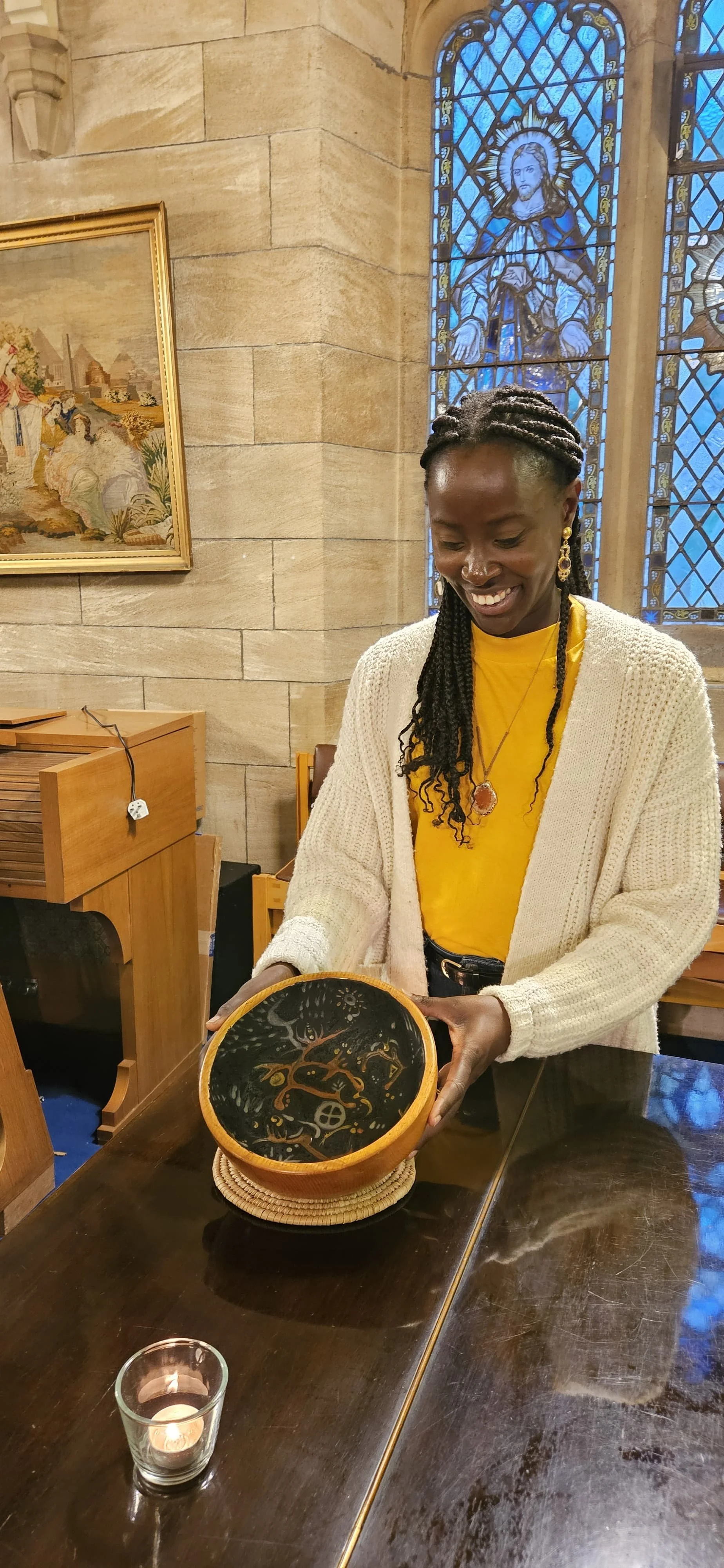
Grace Browne is a multidisciplinary artist based in Glasgow. Her fluid practice includes visual arts, film and socially engaged arts. Her research roots in uli, and inale the ancient body and mural arts of her Igbo and Idoma foremothers.
Guided by nature, the original teacher, Browne creates portals for reconstructing and reimagining ancestral knowledge. She works with foraged earth pigments and natural materials to tell stories of “re-membering” relationships with ecology, ancestry and the body. Her work in community engagement informs her socially driven practice.
Browne’s recent commissions include a short film with GMAC Films Little Pictures (2023), community public art project with The Hidden Gardens (2024), and a public art commission for Sustrans (2021). She has presented solo exhibitions and performances at Market Gallery (2024) and Woodlands Methodist Church (2024). She also delivers earth pigment making workshops with community organisations and hosts the African Women’s Art podcast.
Browne has a BSc in Architecture from UCL (2012) and Dip Arch from Glasgow School of Art, (2014).
INTERVIEW
How did you get into your creative practice? What initially inspired you?
During 2020, I was seeking spaces of hope and was inspired by Beyonce’s ‘Black is King’ to look into my Nigerian “traditional” arts. I found out about uli, the Igbo body and wall art that was practiced by women in my family until my great-grandmother and it opened up worlds for me. I realised that my love of art and architecture came from my ancestors, it helped me feel rooted and gave me the confidence to restart my creative practice.
Researching African women’s arts was challenging when I first started, so last year I began the African Women’s Art podcast to celebrate our work in our voices. It’s great having conversations with brilliant & inspiring artists, researchers and knowledge holders.
What themes do you tend to interrogate in your creative practices?
My creative practice helps me understand, learn and re-member my Igbo and Idoma foremother’s arts and the ancient knowledge systems they carry. Their intergenerational passing has been disrupted and many “traditional” arts are now demonised in Nigerian culture due to the legacies of colonialism and Christianity. My practice is a joyful reclamation. I think of re-membering as reconstructing their memory and meaning as well as reimagining new forms and stories. The themes I enjoy exploring are working with nature as my teacher, folk stories and songs as guides and creating portals for embodied listening.
What is your favourite project you’ve ever worked on and why?
It’s hard to choose one project so I'll go with a pivotal period of time. The summer of 2022 is really special to me. It’s when I began solely focusing on my art practice and it was scary being in the unknown and wondering if I could do this. I had the space & support to play, experiment and rest. Many of the threads, ideas and conversations I explored became the seeds of later projects and things that are still percolating. That time also helped me think about the values that inform my creative process and the ways I share my work.
What advice would you have for creatives of colour looking to get into your creative practices?
I’d say take the time to explore the things that you find interesting. Find and nurture your community and supporters, even if it’s just one person, share your work with them when you’re ready. Go where you are celebrated and cared for. Find a financial flow that works for you and keep adjusting. Trust the times when you aren’t creating and rest if you are able to, winter is as important as summer.
What are you currently working on?
I’m currently reflecting and trying to take time to celebrate. In the upcoming year I will be continuing to develop the African Women’s Art podcast and I hope to do more screenings of my short film ‘OGODO.’ Research wise I'll be carrying on the themes of learning from the rest of nature focusing on water as a teacher.